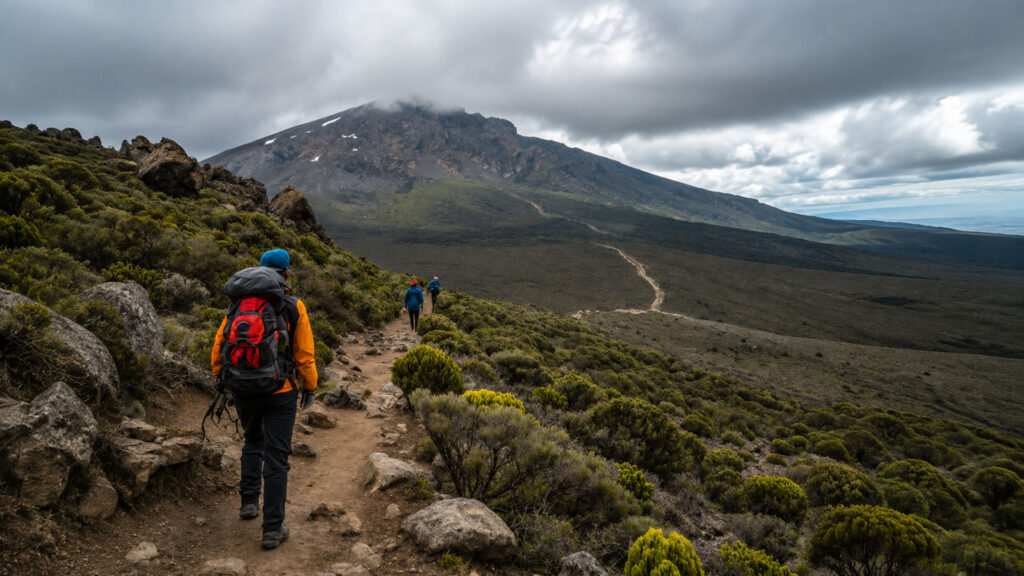
Sunrise at Uhuru Peak
Stand on the Roof of Africa as the sun rises over the glaciers.
Stand on Uhuru Peak (5,895 m), the Roof of Africa. Proven acclimatisation schedules, licensed guides and fair-paid porters give you the best chance of reaching the summit — safely.
Kilimanjaro needs no ropes or technical skills — but it is a serious high-altitude trek. Reaching the summit usually comes down to two things: enough days to acclimatise and experienced guides who know when to push and when to slow down.
Not sure which route suits you? Read our route comparison guide or ask our team.
Uhuru Peak 5,895 m · Challenging
The most popular route on Kilimanjaro – stunning scenery, excellent acclimatisation and a high summit success rate.
Uhuru Peak 5,895 m · Challenging
Our top pick for summit success: a quiet, scenic western route with an extra day for acclimatisation.
Uhuru Peak 5,895 m · Moderate - challenging
The only Kilimanjaro route with hut accommodation – with an extra acclimatisation day at Horombo.
Uhuru Peak 5,895 m · Moderate - challenging
A quiet, drier route from the northern side – excellent for the rainy season and for less-experienced hikers.
Uhuru Peak 5,895 m · Challenging (but gradual)
The longest route on Kilimanjaro: nine days of near-solitude and the best acclimatisation of all.
| Route | Days | Scenery | Traffic | Best for |
|---|---|---|---|---|
| Machame | 7 | Excellent | Busy | Most climbers |
| Lemosho | 8 | Excellent | Moderate | Highest success |
| Marangu | 6 | Good | Busy | Hut accommodation |
| Rongai | 7 | Good | Quiet | Rainy season |
| Northern Circuit | 9 | Outstanding | Very quiet | Best acclimatisation |
Climbing Kilimanjaro is like walking from the equator to the Arctic in a week. Here is what you will pass through.
800–1,800 m · coffee and banana farms of the Chagga people
1,800–2,800 m · colobus & blue monkeys, giant ferns
2,800–4,000 m · giant groundsels and lobelias
4,000–5,000 m · lunar landscapes and big skies
5,000–5,895 m · glaciers and the crater rim at Uhuru Peak
Your cheeky companion at every camp
Highlights on and around the mountain that make the climb unforgettable.
Stand on the Roof of Africa as the sun rises over the glaciers.
A fun, non-technical hands-on climb with incredible views.
Camp above a sea of clouds with Kibo glowing at sunset.
Learn how Kilimanjaro coffee is grown and roasted before or after your climb.
Acclimatise on Tanzania’s second-highest peak before Kilimanjaro.
A beautiful hike to a 70 m waterfall on the lower slopes.
You should be able to walk 5–8 hours a day for several days. Regular hiking, stairs or cycling for 2–3 months beforehand helps a lot.
Late June–October and January–early March are driest. April–May and November are wetter but quieter; Rongai is a good choice then.
Acclimatisation-friendly schedules, twice-daily oxygen checks, emergency oxygen and a clear evacuation plan. Your safety always comes first.
Tarangire, Ngorongoro
A compact, fully private safari to Tarangire and the Ngorongoro Crater – ideal before or after a Kilimanjaro climb or Zanzibar.
Tarangire, Serengeti, Ngorongoro
Tarangire, a night in the Serengeti and the Ngorongoro Crater – the essential Northern Circuit in four days.
Stone Town, Nungwi
Two sides of Zanzibar in four days: the history of Stone Town and the white sands of Nungwi.
Share your dates, group and dream experiences. A Tobiko trip designer in Arusha replies within 24 hours with a free, fully personalised itinerary and quote — no obligation.